Hyundai VIN decoder

Free Hyundai VIN decoder: lookup windows sticker / build sheet options

Example: KMHDC8AEXCU145024


Home → Hyundai

Every Hyundai car is assigned a unique 17-digit number known as the vehicle identification number (VIN). This code, consisting of letters and numbers, is used by various businesses, including Hyundai manufacturers, dealerships, and insurance companies, to identify and track a particular vehicle.

By using a VIN decoder, you can input the VIN of your Hyundai to uncover more about the encoded data, which includes information about the vehicle's make, model, production history, and other features. This tool can help you learn more about your one-of-a-kind Hyundai. Fun fact: Hyundai is a South Korean automaker founded in 1967, known for producing a range of vehicles, including sedans, hatchbacks, and SUVs that are popular in the United States.

John - out author and car expert

By John Devn

our car expert

2 minutes read

Updated 2023-04-04

Excellent

star star star star star

Based on 50 reviews

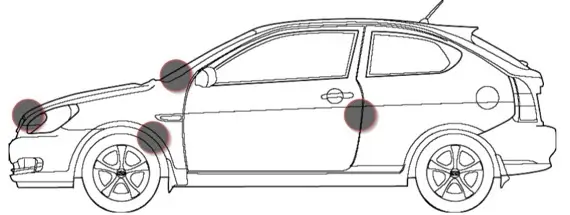
Where to find Hyundai VIN number

There are several locations where you can find the VIN to accurately identify a specific motor vehicle. The vehicle identification number, or VIN, is a unique code that can be found:

  • On the driver's side of the dashboard, near the base of the windshield. It should be visible from outside the vehicle through the glass.
  • On the spot where the driver-side door hinge attaches to the vehicle's frame when the door is closed.
  • In literature related to automobiles, such as the owner's manual.
  • On documents such as the title, registration, and insurance policies, which may be kept at home, in the glove compartment, or in the trunk.
  • On the engine block, which is often located near the front of the engine and may be engraved.
  • On the frame or undercarriage of the vehicle.
  • On the transmission. It's worth noting that if a motor vehicle history report is available for the car, the VIN may also be listed on it. This report details information about the ownership, maintenance, and accident history of the vehicle.
Where to find Hyundai VIN number
Chart option of VIN number

Chart option of VIN number

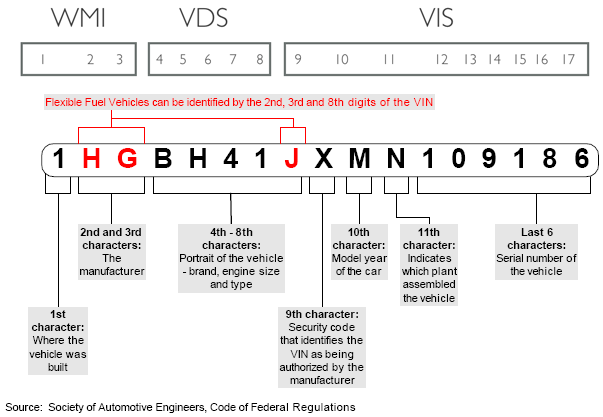
The World Manufacturer Identifier (WMI), also known as WMI, is a unique code that identifies the manufacturer of a Hyundai vehicle. It is typically the first three characters of a VIN and helps determine the country of origin, manufacturer, and vehicle type. Here are some examples of WMI codes for Hyundai vehicles:

WMI code Location Description Date
2HM Canada   2009-03-22
3H3 USA Trailers and semi-trailers 2008-09-26
KM2-KM7 Korea Buses 2007-06-16
KMC-KMP Korea Buses and minivans 2007-06-16
KMR Korea Buses 2007-06-16
KML Korea HYUNDAI KM Korea Cars, minivans 1899-12-31
KM8 Korea Buses and minivans 1899-12-31
KME Korea Tractors 2009-03-22
KMF Korea Cars and minivans 1899-12-31
KMH Korea   1899-12-31
KMJ Korea Buses 1899-12-31
KMX Korea SUV 2007-02-27
KMY Korea Buses 2009-03-22
KMZ Korea Minivans 2009-03-22
KN1-KN2 Korea Buses 2007-06-16
KNV Korea   2007-06-16
KRT-KRU Korea Buses 2007-06-16
KNH Korea   2009-06-09
KNN Korea Passenger Cars 2012-02-01
MAL-MC3 India   2009-03-22
NA6 Iran   2016-09-23
NLH Turkey   2006-12-18
NLJ Turkey Commercial 2007-02-27
X7M Russia   1899-12-31
X89 DV8 Russia   2012-08-01
XU7 Russia Buses 2007-03-01
Y6L Ukraine   2009-06-16
Z94 Russia   2011-

The Vehicle Descriptor Section (VDS) is a component of the VIN that provides detailed information about the vehicle's model, exterior design, powerplant type, and gearbox. It generally consists of six to seven characters that can be used to determine the vehicle's original configuration and check for any modifications.

The Vehicle Identification Section (VIS) is another aspect of the VIN that provides detailed information about the vehicle, such as its model, exterior design, powerplant type, and gearbox. The VIS typically consists of six to eight characters that can be used to determine the vehicle's characteristics, place of origin, build sequence, and production year.

What you can know from VIN decoder tool

A tool for decoding VIN can provide various information about a vehicle, such as:

  • Make, model, and year of the vehicle
  • Engine type and size
  • Transmission type
  • Trim level, options, and packages
  • Vehicle body style and door count
  • Location of vehicle manufacturing
  • Safety equipment and features
  • Production date and sequence number
  • Color and interior trim of the vehicle
  • Fuel efficiency and emissions rating
  • Recall and service bulletins
  • Manufacturer's warranty information
  • Registration and title information

Example of free VIN decoding

The VIN number "KMHDC8AE0CU156128" belongs to a 2012 Hyundai Elantra Touring SE.

  • 1st character (K): Indicates the country of origin, which in this case is South Korea
  • 2nd-3rd characters (MH): Indicates the manufacturer, which in this case is Hyundai
  • 4th-8th characters (DC8AE): Identifies the model, which in this case is Hyundai Elantra Touring SE
  • 9th character (0): Check digit used to ensure the accuracy of the VIN
  • 10th character (C): Identifies the model year, which in this case is 2012
  • 11th character (U): Identifies the manufacturer's plant code, which in this case is Ul-san, South Korea
  • 12th-17th characters (156128): Identifies the production number, used to identify the specific vehicle within the production run.

Using this breakdown of the VIN, we can determine that this is a 2012 Hyundai Elantra Touring SE Wagon with Displacement CC: 2000.0, manufactured in Ul-san, South Korea, by Hyundai-Kia America Technical Center Inc (HATCI).

What you can know from VIN history

Alternatively referred to as a VHR, a vehicle history report can offer additional details about a vehicle's past, including:

  • Reports of damage, repairs, and accidents
  • Records of services and maintenance
  • Defects, safety notices, and recalls
  • Odometer readings and history of rollbacks
  • Fire or flood damage; salvage or scrap status
  • Lemon history
  • Complete loss records
  • Test results for emissions
  • Details of the title and registration
  • License plates
  • Insurance reports and claims
  • Rollback histories and odometer readings

Buying a used Hyundai? Reliability, problems & recalls


Reliability. RepairPal rates Hyundai 4.0 out of 5.0, ranking it 4th out of 32 car brands. Average annual repair cost is $468 vs. the industry average of $652, with 0.3 unscheduled shop visits per year vs. a 0.4 industry average, and a 10% probability of a severe repair vs. 12% industry-wide. In J.D. Power's 2025 U.S. Initial Quality Study, Hyundai ranked second among mass-market brands and third overall in the industry for the second consecutive year. Consumer Reports notes that Hyundai's long-running hybrid drivetrains often match or exceed the reliability of their gas-only counterparts, though some newer electrified models have scored below average. Source: repairpal.com

Resale value. The Hyundai Elantra retains approximately 62.9% of its value after five years, reflecting a 37.1% five-year depreciation — better than the iSeeCars industry average of 41.5% for all vehicles. The Hyundai Accent subcompact holds its value even better at a 67% five-year resale rate, ranking among iSeeCars' best-value subcompact cars. Note that the 10-year/100,000-mile powertrain warranty reverts to 5-year/60,000-mile coverage for subsequent owners, which can affect resale appeal on higher-mileage used examples. Source: iseecars.com

Theft risk. A serious and well-documented theft epidemic affects 2015–2021 Hyundai models (and some earlier years) that were sold without standard electronic engine immobilizers. Starting in 2021, a… Source: iihs.org

Most-reported problems on used Hyundais

  • Theta II 2.0T/2.4L GDI engine failure
  • Nu 2.0L MPI engine failure
  • ABS module internal brake fluid leak causing electrical short and engine compartment fire risk, even when parked. Subject of NHTSA recall 23V-651 affecting approximately 1.64 million Hyundai and Genesis vehicles with a 'park outside' advisory.
  • Excessive engine oil consumption
  • DCT/automatic transmission hesitation and jerking
  • Premature engine mount failure causing excessive vibration

Notable safety recalls (NHTSA)

  • 15V-568 — Metal debris from factory crankshaft machining could restrict oil flow to connecting rod bearings, causing premature bearing…
  • 17V-226 — Same machining-debris defect as 15V-568 extended to subsequent model years after Hyundai monitored increasing warranty claims…
  • 21V-301 — Defective piston oil rings can cause excessive oil consumption, engine stalling, and fire risk. Approximately 125,840 vehicles…

Confirm open recalls free by VIN at nhtsa.gov/recalls. Sources: NHTSA, plus the reliability and resale data linked above.

Models of Hyundai


Several factors make this possibility possible, including:

  • The plate could have been altered with paint or other materials, and the VIN could have gone missing.
  • The VIN may have been purposefully deleted by the vehicle's owner or by someone who wanted to hide the car's identity.

  • Reach out to the manufacturer of the vehicle. They may be able to provide records of the VIN or guidance on obtaining them.
  • If feasible, contact the car's original dealership. They could have information on where to locate the VIN for you or may already have records of it.

All information about Hyundai on this page is based on data from:

NHTSA logo

NHTSA

SaferCar logo

SafeCar

NMVTIS logo

NMVTIS