Honda VIN decoder

Free Honda VIN decoder: lookup windows sticker / build sheet options

Example: 5FNRL5H65DB056768


Home → Honda

Each Honda car is given a different 17-character identifier called a vehicle identification number (VIN). This code is made up of letters and digits and is displayed on the car itself. It is used by various institutions, including Honda manufacturers, dealerships, and insurance companies, to identify and monitor the exact vehicle.

By using a tool called a VIN decoder, you can enter your Honda VIN to find out more about the encoded data, which includes information on the vehicle's brand and model, history of manufacture, and other features. This tool can help you better understand your one-of-a-kind Honda. Fun fact: Honda is a Japanese automaker that was founded in 1948 and is known for producing a variety of vehicles including cars, motorcycles, and power equipment that are popular around the world.

John - out author and car expert

By John Devn

our car expert

2 minutes read

Updated 2023-04-04

Excellent

star star star star star

Based on 50 reviews

Where to find Honda VIN number

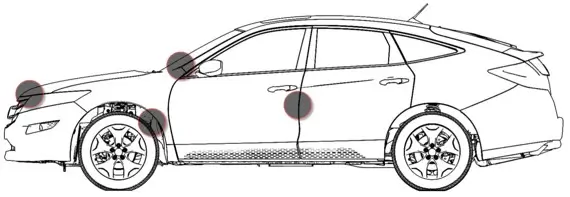
Where can the vehicle code be found with precision? A certain automobile can be identified by its vehicle code, which is a unique identifier. It can be located in various places, such as:

  • On the driver's side of the dashboard, towards the bottom of the windshield. It should be visible from the exterior through the glass.
  • On the location where the driver-side door jamb connects to the car's frame when closed.
  • In literature related to cars, such as the owner's handbook.
  • On documents such as the title, registration, and insurance policies, which can be kept at home, in the glove compartment, or in the trunk.
  • On the engine block, which is often located near the front of the engine, and may be engraved.
  • On the transmission. It's worth noting that if a motor vehicle history report is available for the car, the vehicle code may also be listed on it. This report details information about the ownership, maintenance, and accident history of the vehicle.
Where to find Honda VIN number
Chart option of VIN number

Chart option of VIN number

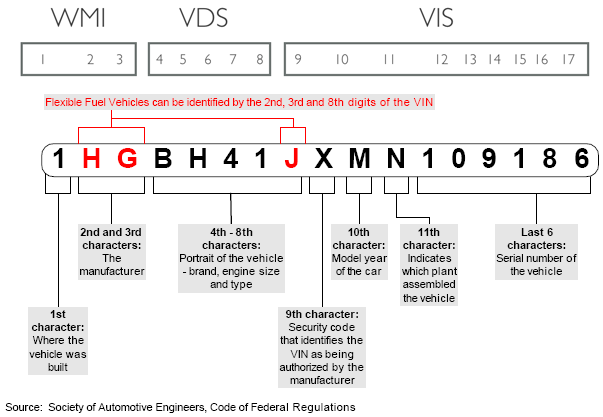
The World Manufacturer Identifier (WMI), commonly referred to as WMI, is a code that identifies the maker of a Honda vehicle. It is usually the first three characters of a VIN, and it helps to determine the country of origin, manufacturer, and type of vehicle. Below are examples of WMI codes for Honda vehicles:

  • JH: Honda Motor Co., Ltd.
  • 1HG: Honda of America Mfg., Inc.
  • 2HG: Honda of Canada Mfg.
  • JHL: Honda Logistics Americas LLC
  • JHM: Honda Motor Co., Ltd.
  • JHN: Honda Manufacturing of Alabama, LLC

A VDS (Vehicle Descriptor Section) is a section of the VIN that provides specific information about the vehicle model, body style, engine type, and transmission. It typically consists of six to seven characters, which can be used to identify the vehicle's original setup and check for any changes.

A VIS (Vehicle Identification Section) is another part of the VIN that provides specific information about the vehicle, such as model, body style, engine type, transmission, attributes, place of origin, production order, and year of manufacture. The VIS typically consists of six to eight characters, which can be used to identify the vehicle.

What you can know from VIN decoder tool

A VIN decoder tool can offer various information about a vehicle, such as:

  • Make, model, and year of the vehicle
  • Engine type and size
  • Transmission type
  • Trim level, options, and packages
  • Vehicle body style and doors count
  • Location of vehicle's manufacturing
  • Safety equipment and features
  • Production date and sequence number
  • Vehicle's color and interior trim
  • Vehicle's fuel efficiency and emissions rating
  • Recall and service bulletins
  • Manufacturer's warranty information
  • Registration and title information

Example of free VIN decoding

The VIN number "JHLRD1742XC005626" belongs to a 1999 Honda CR-V LX.

  • The 1st character (J) indicates the country of origin, in this case, Japan.
  • The 2nd-3rd characters (HL) indicate the manufacturer, in this case, Honda.
  • The 4th-8th characters (RD174) identify the model, in this case, it is the Honda CR-V LX.
  • The 9th character (2) is the check digit, used to ensure the accuracy of the VIN.
  • The 10th character (X) identifies the model year, in this case, it is 1999.
  • The 11th character (C) identifies the manufacturer's plant code, in this case, it is Sayama, Saitama, Japan.
  • The 12th-17th characters (005626) identify the production number, used to identify the specific vehicle within the production run.

By using this breakdown of the VIN, we can determine that this is a 1999 Honda CR-V LX manufactured in Sayama, Saitama, Japan, by Honda Motor Co., Ltd.

What you can know from VIN history

A vehicle history report, also known as a VHR, can provide additional information about a car's history, such as:

  • Past ownership and registration
  • Accidents, repair, and damage reports
  • Service and maintenance records
  • Recalls, safety alerts, and defects
  • Odometer readings and rollback history
  • Salvage or scrap status
  • Flood or fire damage
  • Lemon history
  • Records of total loss
  • Emissions test results
  • Title and registration information
  • Plate numbers
  • Insurance claims and reports
  • Odometer readings and rollback history

Buying a used Honda? Reliability, problems & recalls


Reliability. RepairPal ranks Honda 1st out of 32 car brands with a 4.0/5.0 reliability rating. Average annual repair cost is $428 vs. the industry average of $652, and only 10% of repairs are severe (vs. 12% industry average). Consumer Reports ranked Honda 4th among all brands for predicted reliability in its 2024 survey (score 59/100). Note: the J.D. Power 2024 U.S. Vehicle Dependability Study (measuring 2021 model-year vehicles after 3 years) scored Honda at 206 PP100 against an industry average of 190 — below average in that study, partly reflecting technology-related complaints rather than mechanical failures. Source: repairpal.com

Resale value. Honda models consistently appear among the lowest-depreciating vehicles in iSeeCars' annual study. Five-year depreciation rates: Honda Civic 22.9%, Honda HR-V 28.8%, Honda CR-V 28.9%, Honda Accord 30.5%. Multiple Honda models rank in the top 25 nationally for retained value. No single make-wide figure is published by iSeeCars. Source: iseecars.com

Theft risk. The Honda Accord ranked 4th on NICB's 2024 most-stolen vehicles list with 18,539 thefts. The Honda Civic and CR-V have also historically ranked in the top ten most stolen vehicles nationally. Buyers… Source: nicb.org

Most-reported problems on used Hondas

  • 1.5-liter turbocharged engine oil dilution
  • Honda Sensing (CMBS) phantom braking
  • A/C condenser corrosion and leaks
  • 3.5-liter V6 (J-series) connecting rod bearing failure
  • Automatic transmission issues on older V6 models
  • Passenger airbag inadvertent deployment

Notable safety recalls (NHTSA)

  • 20V026 and 20V027 — Takata non-azide driver inflator (NADI) airbag recall — Takata non-azide driver inflators (NADI) can rupture and propel metal fragments into occupants. Separate from the larger PSAN…
  • Takata PSAN Alpha inflator recalls (original campaigns 08V-593, 09V-259, 10V-041, 11V-260) — 'Do Not Drive' advisory issued February 2023 — Takata PSAN ammonium-nitrate airbag inflators can explode in a crash, spraying metal fragments. Long-term heat and humidity…
  • 24V-064 — Front passenger seat weight sensor / airbag may deploy unintentionally — A capacitor in the front passenger seat weight sensor printed circuit board may crack due to humidity, causing a short circuit…

Confirm open recalls free by VIN at nhtsa.gov/recalls. Sources: NHTSA, plus the reliability and resale data linked above.

Models of Honda


There are various reasons why a vehicle may not have a visible VIN, including:

  • The plate may have been disguised by paint or other methods, or the VIN may have been misplaced.
  • The owner of the vehicle or an individual looking to conceal the identity of the vehicle may have deliberately removed the VIN.
    • Contact the manufacturer of the vehicle. They may have records of the VIN or be able to provide information on how to acquire it.
    • If known, get in touch with the dealership where the car was purchased. They may be able to assist you in obtaining the VIN or may already have records of it.

    All information about Honda on this page is based on data from:

    NHTSA logo

    NHTSA

    SaferCar logo

    SafeCar

    NMVTIS logo

    NMVTIS