RAM VIN decoder

Free RAM VIN decoder: lookup windows sticker / build sheet options

Example: 3C6LRVBG3RE148052


Home → RAM

Referred to as a Vehicle Identification Number, each Ram vehicle is assigned a unique 17-digit identification code (VIN). This code, consisting of characters and digits, can be found on the actual vehicle. It is used by various businesses, including Ram, car dealerships, and insurance companies, to identify and track a specific vehicle. By utilizing a RAM VIN decoder, you can learn more about the information encoded in the VIN of your Ram, such as the brand and model of the vehicle, its production history, and other details. Doing so will help you better understand your specific Ram. Fun fact: Ram is a brand of trucks and commercial vehicles that was established in 1909 as the Dodge Brothers Company and is now a division of the American car company FCA US LLC.

John - out author and car expert

By John Devn

our car expert

2 minutes read

Updated 2023-04-03

Excellent

star star star star star

Based on 50 reviews

Where to find RAM VIN number

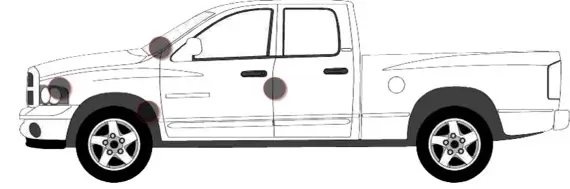
Location of the VIN number
A unique code called the vehicle identification number (VIN) is used to identify a specific car. It can be found in various places, including:

  • On the driver's side dashboard, towards the bottom of the windshield. It should be visible from the outside through the windshield.
  • On the engine block: The engine block, usually located near the front of the engine, may have the VIN stamped on it.
  • On the frame or chassis: The vehicle's frame or chassis may bear the VIN imprint.
  • On the transmission: The vehicle's transmission may also display the VIN.
  • The VIN will be included in any vehicle history report for the car if one is available. This report goes into detail about the ownership, maintenance, and accidents involving the vehicle.
  • In vehicle-related material, such as the owner's manual, the VIN is often listed.
  • In other documents, such as the title, registration, and insurance paperwork: These documents may be kept at home, in the glove box, or in the trunk.
Where to find RAM VIN number
Chart option of VIN number

Chart option of VIN number

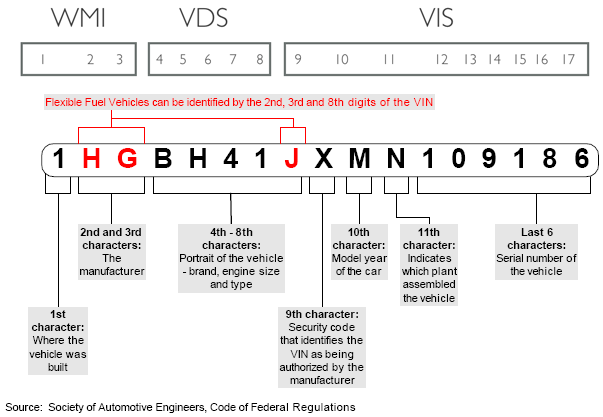
The World Manufacturer Identifier (WMI), also known as WMI, is a unique code that identifies the manufacturer of a vehicle. It usually represents the first three characters of the VIN and helps identify the country of origin, manufacturer, and vehicle type. For Ram vehicles, the WMI code is "1C" as the first characters of the VIN indicate that the vehicle was manufactured by Chrysler in the United States.

The Vehicle Description Section (VDS) is a section of the VIN that provides specific information about the vehicle model, body design, propulsion system, and transmission. It typically consists of six to seven characters, which can be used to identify the vehicle's original configuration and check for any alterations.

The Vehicle Identification Section (VIS) is another part of the VIN that provides specific information about the vehicle, such as the model, body design, propulsion system, and transmission. The VIS typically consists of six to eight characters, which can be used to identify the vehicle's features, place of assembly, production sequence, and model year.

What you can know from VIN decoder tool

A VIN decoder tool can provide various information about a vehicle, such as:

  • The make, model, and year of the vehicle
  • The engine type and size
  • The transmission type
  • The trim level, options, and packages
  • The vehicle body style and number of doors
  • The location of vehicle manufacturing
  • The safety equipment and features
  • The production date and sequence number
  • The color and interior trim of the vehicle
  • The fuel efficiency and emissions rating
  • The recall and service bulletins
  • The manufacturer's warranty information
  • The registration and title information

Example of free VIN decoding

The VIN number "3D7UT2HL4BG560451" belongs to a 2011 Ram 2500 (Laramie Longhorn Edition) Pickup truck.

  • The 1st character (3) indicates the country of origin, in this case, it is Mexico
  • The 2nd character (D) indicates the manufacturer, in this case, it is Chrysler
  • The 3rd character (7) identifies the vehicle type or manufacturing division, in this case, it is Ram
  • The 4th-8th characters (UT2HL) identify the model, in this case, it is Ram 2500
  • The 9th character (4) is a check digit used to ensure the accuracy of the VIN
  • The 10th character (B) identifies the model year, in this case, it is 2011
  • The 11th character (G) identifies the manufacturer's plant code, in this case, it is Saltillo, Mexico
  • The 12th-17th characters (560451) identify the production number, used to identify the specific vehicle within the production run

Using this breakdown of the VIN, we can determine that this is a 2011 Ram 2500 (Laramie Longhorn Edition) Pickup truck with Displacement CC: 6700.0. It was manufactured in Saltillo, Mexico by Chrysler de Mexico Toluca.

What you can know from VIN history

Alternatively referred to as a VHR, a vehicle history report can provide supplementary information about a vehicle's past, such as:

  • Accounts of damage, repairs, and accidents
  • Logs of services and maintenance
  • Flaws, safety alerts, and recalls
  • Mileage readings and history of rollbacks
  • Fire or flood damage; salvage or scrap status
  • Lemon history
  • Records of total loss
  • Test results for emissions
  • Data of the title and registration
  • License plate numbers
  • Insurance claims and reports
  • Rollback histories and odometer readings

This could occur for a number of reasons, including:

  • The VIN may have been purposely removed by the owner or someone attempting to conceal the identification of the car
  • The plate may have been damaged or covered up, such as by painting over it, or the VIN may have been lost

The following steps can be taken if you discover that the VIN of a vehicle is missing:

  • Reach out to the vehicle's manufacturer. They could provide guidance on how to retrieve the VIN or have records of it.
  • Contact the dealership where the vehicle was bought, if known. They may have records of the VIN or be able to assist in obtaining it.

All information about RAM on this page is based on data from:

NHTSA logo

NHTSA

SaferCar logo

SafeCar

NMVTIS logo

NMVTIS

Ram reliability & resale value


Reliability. RepairPal rates the Ram 1500 3.5 out of 5.0 (Above Average), ranking it 1st out of 17 full-size trucks, with an average annual repair cost of $691 and an unscheduled shop visit frequency of 0.2 times per year — below the fullsize-truck average of 0.3. The Ram 1500 won the J.D. Power 2024 U.S. Initial Quality Study Full-size Light-Duty Pickup class (Ram was #1 overall brand), the only truck-exclusive marque to top the industry ranking. Consumer Reports reliability verdicts vary: the 2024 Ram 1500 scores 'about average' compared to same-year vehicles, and some earlier model years (e.g., 2019–2022) have scored below average in CR surveys. Long-term reliability differs from initial quality — IQS measures problems in the first 90 days of ownership, not multi-year durability. Source: repairpal.com

Resale & depreciation. According to iSeeCars analysis of over 3 million vehicles, the Ram 1500 ranks #2 among full-size trucks for best 5-year resale value, retaining 62.2% of its original value (average price $36,093 for a 5-year-old model), which is 0.5% above the full-size truck average of 61.7%. KBB projects a 2025 Ram 1500 Crew Cab will depreciate approximately $24,419 over 5 years, leaving a residual value around $20,701. Heavy-duty models retain value even better: iSeeCars shows the Ram 3500 retaining 82.6% and the Ram 2500 retaining 77.4% after 5 years. Source: iseecars.com

Theft risk: Ram pickup trucks are a notable theft target. According to HLDI (Highway Loss Data Institute) analysis of 2022–24 model years, the Ram 1500 crew cab short-wheelbase 4WD has a relative theft claim frequency of 524 (vs. an all-vehicle average of 100), placing it in the top 20 most-stolen vehicles nationally. The Ram 3500 crew cab long-wheelbase 4WD sits at 387. Full-size 4WD crew cab pickups as a category have among the highest theft rates of any vehicle type. Buyers of used Ram trucks should verify the vehicle history for theft-related incidents. Source: iihs.org

Common problems on used Rams


  • 5.7L HEMI MDS lifter tick and failureAffected: Ram 1500, 2500 with 5.7L HEMI V8; most reported on 2009–2023 models equipped with Multi-Displacement System (MDS). Source: hotshotsecret.com
  • 3.0L EcoDiesel EGR cooler cracking and intake manifold fire riskAffected: 2014–2019 Ram 1500 with 3.0L EcoDiesel engine (NHTSA recall 19V757000 / campaign VB1). Source: static.nhtsa.gov
  • 3.0L EcoDiesel crankshaft position sensor loss / engine stall while drivingAffected: 2014–2018 Ram 1500 with 3.0L EcoDiesel (NHTSA recall 20V475 / campaign W58); expanded under 23V411 to 2014–2020 models. Source: static.nhtsa.gov
  • 8.4-inch UConnect infotainment system freezing, rebooting, GPS inaccuracy, and slow startupAffected: Ram 1500, 2500, 3500 with 8.4-inch UConnect 4C; widely reported on 2013–2022 models. Source: carcomplaints.com
  • 68RFE 6-speed automatic transmission overheating, slipping, and fluid expulsion from dipstick tubeAffected: 2019–2023 Ram 2500 and 3500 with 6.7L Cummins diesel and 68RFE (NHTSA recalls 20V043 and 22V835). Source: repairpal.com
  • Tailgate latch failure — tailgate may open unexpectedly while drivingAffected: 2015–2018 Ram 1500/2500/3500 (NHTSA 19V347 / V44); also 2019–2022 Ram 1500/2500/3500 (NHTSA 22V904 / ZB8). Source: static.nhtsa.gov
  • Rear driveshaft weld fracture — driveshaft can separate and become a road hazardAffected: 2018–2019 Ram 1500 4x4 built March–April 2018 (NHTSA 19V324 / V48). Source: static.nhtsa.gov
  • Cooling fan module overheating and vehicle fire risk (fleet-built vans)Affected: 2018–2026 Ram ProMaster (fleet-built units; NHTSA 25V720 / campaign 67C). Source: nhtsa.gov

Notable Ram recalls (NHTSA)


  • NHTSA 19V757000 (manufacturer: VB1)The EGR cooler may crack due to thermal fatigue, allowing vaporized coolant to enter the EGR system. This mixture can combust inside the intake manifold, creating a fire risk. Remedy: EGR cooler replacement.2014–2019 Ram 1500 with 3.0L EcoDiesel engine. Source: static.nhtsa.gov
  • NHTSA 20V475000 (manufacturer: W58)Loss of crankshaft position signal can cause an engine stall while driving, with no warning and possible inability to restart. Remedy: PCM software reprogram to maintain engine operation if signal is lost.2014–2018 Ram 1500 with 3.0L EcoDiesel engine; later expanded under 23V411 to 2014–2020 models. Source: static.nhtsa.gov
  • NHTSA 22V904000 (manufacturer: ZB8)Tailgate strikers may be misaligned, preventing the tailgate from latching properly. An improperly latched tailgate may open unexpectedly while driving. Remedy: dealer inspection and realignment of striker.2019–2022 Ram 1500, 2500, and 3500 pickup trucks (approx. 1,234,650 vehicles). Source: static.nhtsa.gov
  • NHTSA 20V043000 (manufacturer: W03)Buildup of pressure and heat in the 68RFE automatic transmission can cause fluid to be expelled from the dipstick tube, potentially contacting an ignition source and causing a fire. Remedy: transmission valve body replacement.2019–2020 Ram 2500 and 3500 with 68RFE transmission (approx. 84,202 vehicles). Source: api.nhtsa.gov
  • NHTSA 25V720000 (manufacturer: 67C)Premature bearing wear in the cooling fan motor combined with inadequate fuse protection on the 400W fan circuit can lead to high current draw and a vehicle fire. NHTSA issued a 'Do Not Drive / Park Outside' advisory pending final remedy.2018–2026 Ram ProMaster fleet vehicles built July 20, 2017 – October 7, 2025 (approx. 291,664 vehicles). Source: static.nhtsa.gov

What to check when buying a used Ram


  • Run the VIN through NHTSA's recall lookup (nhtsa.gov/recalls) to confirm all open campaigns — multiple tailgate, EcoDiesel, and driveshaft recalls affect large volumes of trucks.
  • On any EcoDiesel-equipped 1500 (2014–2019), verify recalls 19V757 and 20V475 have been completed; check for signs of coolant intrusion or uneven idle.
  • On 5.7L HEMI models, listen for a ticking or tapping noise at startup (MDS lifter tick); ask for oil change records and check for any engine codes P0300–P0308 indicating misfires from collapsed lifters.
  • On Ram 2500/3500 with 6.7L Cummins diesel, confirm 68RFE transmission recall 20V043 is closed; check transmission fluid color and smell for signs of overheating.
  • Test the 8.4-inch UConnect display for freeze/reboot behavior, GPS accuracy, and backup camera function; software-only issues can sometimes be resolved with a dealer update.
  • Inspect the tailgate for misalignment, difficulty latching, or any history of dropping open — multiple NHTSA campaigns (19V347, 22V904) cover different generations.
  • On ProMaster vans, verify recall 25V720 status; fleet-duty vans are at elevated risk if the cooling fan bearing has not been replaced.
  • Check for any signs of rust on the rear axle, frame (especially in salt-belt states), and driveshaft U-joints — Ram heavy-duty trucks used for towing are prone to accelerated undercarriage wear.
  • Verify the eTorque mild-hybrid battery (where equipped on 2019+ 1500) hasn't triggered persistent electrical fault codes.
  • Review the full service history: HEMI lifter failures are strongly correlated with extended oil change intervals or use of non-recommended oil viscosity.

Ram — frequently asked questions


Are used Ram trucks reliable?
It depends on the model year and powertrain. RepairPal rates the Ram 1500 3.5 out of 5.0 — 1st out of 17 full-size trucks — with an average annual repair cost of $691 (repairpal.com/reliability/ram/1500). The Ram 1500 also won the J.D. Power 2024 U.S. Initial Quality Study for the Full-size Light-Duty Pickup class (media.stellantis.com). However, J.D. Power's IQS measures only the first 90 days of ownership, not long-term durability. Consumer Reports reliability verdicts are mixed: the 2024 Ram 1500 scores 'about average,' and certain earlier model years score below average in owner surveys. Specific concerns — 5.7L HEMI MDS lifter failure, 3.0L EcoDiesel EGR and emissions recalls, and 68RFE transmission issues on heavy-duty models — make model-year and powertrain selection important.
What are the most common problems with used Rams?
The most widely documented issues include: (1) 5.7L HEMI MDS lifter ticking and potential lifter collapse, especially when oil changes were infrequent; (2) 3.0L EcoDiesel EGR cooler cracking with fire risk (NHTSA recall 19V757) and crankshaft position sensor stall risk (recall 20V475); (3) 8.4-inch UConnect freezing, slow boot, and GPS errors across 2013–2022 models; (4) 68RFE automatic transmission overheating, slipping, and fluid leaks on 2019–2022 Ram 2500/3500 (recall 20V043); and (5) tailgate latch failures on 2015–2022 models across multiple recall campaigns (19V347, 22V904). CarComplaints.com lists the 2014 Ram 1500 as the worst model year, with power steering failure as the #1 complaint averaging $3,100 to fix.
Do Ram trucks hold their value?
Yes — Ram 1500 ranks #2 among full-size trucks for 5-year resale value according to iSeeCars, retaining 62.2% of its original value (iSeecars.com/resale-value/full-size-trucks). Heavy-duty models are even stronger: the Ram 3500 retains 82.6% and the Ram 2500 retains 77.4% over 5 years. KBB projects a 2025 Ram 1500 Crew Cab will depreciate about $24,419 over five years (kbb.com). Strong pickup truck demand overall supports resale, with well-maintained, lower-mileage trucks and popular trims (Laramie, Big Horn) commanding the best prices.
How do I check a Ram for open recalls?
Enter the truck's 17-digit VIN at nhtsa.gov/recalls — NHTSA's free federal recall lookup. This will show all open safety recalls issued by the manufacturer. You can also check via Ram's owner portal at mopar.com. Multiple high-volume Ram recalls remain partially open (tailgate latch, EcoDiesel stall, driveshaft), so this step is especially important before purchasing any used Ram.
What should I look for when buying a used Ram?
Verify all open NHTSA recalls have been completed via the VIN lookup at nhtsa.gov/recalls. On EcoDiesel 1500s, confirm recalls 19V757 and 20V475 are closed and check for coolant intrusion signs. On HEMI V8 models, listen for lifter tick at cold start and request oil-change records. On Ram 2500/3500 with Cummins and 68RFE, test the transmission under load and check for overheating history. Test the UConnect display thoroughly. Inspect the tailgate for proper latching. For ProMaster vans, verify recall 25V720 status. A pre-purchase inspection by an independent mechanic is strongly recommended for any used Ram with over 60,000 miles.
Is the 3.0L EcoDiesel a good engine for a used Ram 1500?
The 3.0L EcoDiesel offers best-in-class diesel fuel economy for a half-ton, but it has a significant recall and reliability history. NHTSA campaigns include a fire-risk EGR cooler recall (19V757000), a crankshaft stall recall (20V475000), and emissions-compliance software updates required under EPA/CARB consent decrees. Per Consumer Reports (consumerreports.org), more than 80,000 EcoDiesel-equipped Ram 1500s and Jeep Grand Cherokees were recalled in 2023 for a tone wheel failure that could cause an engine stall while driving (NHTSA 23V411). Before buying any EcoDiesel Ram, confirm all open recalls have been remedied using the NHTSA VIN lookup.
Are Ram ProMaster vans reliable for fleet or commercial use?
The ProMaster has been a popular front-wheel-drive commercial van, but it carries a major active recall: NHTSA campaign 25V720000 (issued October 2025) covers approximately 291,664 fleet-built 2018–2026 ProMasters for a cooling fan fire risk. NHTSA issued a 'Do Not Drive / Park Outside' advisory pending a final fix. Potential buyers should check the VIN at nhtsa.gov/recalls before purchasing any ProMaster van.
Which Ram 1500 model years are best to buy used?
The fifth-generation Ram 1500 (2019–present) generally has stronger reliability scores than earlier generations. CarComplaints.com identifies the 2014 Ram 1500 as the worst model year overall for complaints. For the 2009–2018 generation, the 2017–2018 model years are often cited by owners as the most trouble-free. Regardless of year, avoid EcoDiesel-equipped trucks unless all EGR and emissions recalls have been confirmed closed. On 5.7L HEMI models, prioritize vehicles with documented regular oil changes and no evidence of lifter noise.